
Bitcoin ETFs: What are they and how do they impact the bitcoiner ecosystem?
After 10 years of seeking approval for a spot bitcoin ETF, Wall Street is finally entering this market.
Genny Díaz ·
Long awaited by Wall Street investors, the approval of spot bitcoin ETFs in the United States finally came at the beginning of this year.
This has become one of the most relevant news stories in the cryptocurrency world in recent times. However, its impact on the Bitcoin ecosystem continues to divide opinion.
For some, they represent the arrival of a mass of new users, the consolidation of adoption and an increase in its price. Others believe that the old ways of the stock markets will permeate the use of bitcoin (BTC), pulling it away from its original premises.
In this article we will explain what an ETF is, and review some of the arguments in this debate.
What are spot bitcoin ETFs?
ETF stands for Exchange Traded Funds. It is a type of financial product that replicates the price movements of an asset or set of assets traded on the stock exchange. These assets can be stocks, bonds and commodities (such as gold), or a combination of them, as in the S&P 500 index, for example.
This type of market instrument allows investors to easily participate in different markets indirectly. In other words, the user acquires a kind of share or stake, instead of the actual asset.
In the case of bitcoin, this means that the investor will not need to buy, sell and custody the BTC, since the company issuing the ETF takes care of managing it entirely.
How do bitcoin ETFs work?
The mechanism is easy to understand. A fund manager, such as Blackrock or another one authorized by regulators, buys bitcoin and keeps it in a secure vault. It then issues the shares that will be traded on the exchange.
When an investor buys a share in a bitcoin ETF, they are actually buying a portion of the bitcoin the fund holds. This allows them to receive a proportion of that fund’s returns, calculated based on bitcoin’s performance.
What advantages and disadvantages do bitcoin ETFs offer?
Some of the most frequently mentioned advantages are:
Accessibility: The investment process is as easy as buying any stock.
Security: It is delegated to the issuing fund, so the investor is freed from this responsibility.
Regulatory Compliance: The issuers of these products must comply with legal requirements, including those related to user protection.
Diversification: The investor can include bitcoin in an investment portfolio to reduce their risk.
The disadvantages include paying management fees, the market risks inherent to bitcoin’s volatility and restrictions on who can access these products.
Favorable opinions
Some opinions suggest that the existence of a product such as spot ETFs is evidence of the growth and maturity of the market. According to this thesis, acceptance by regulators, such as the U.S. Securities and Exchange Commission, gives Bitcoin greater legitimacy as an investment asset.
It is also said that thanks to the ease of use for investors, demand for the cryptocurrency could increase significantly. This is explained by the fact that ETFs remove the learning barrier currently required to manage BTC on your own.
In addition, it is believed that the entry of institutional capital into the bitcoin market will generate greater confidence, increase its valuation in USD and reduce volatility.
What the critics say
ETF detractors believe that Wall Street’s foray into bitcoin will not be as beneficial as some think. According to these opinions, the impact on the price would be limited and temporary, because bitcoin is already a very liquid asset. Furthermore, its market is influenced by various factors such as supply, mining, competition, innovation, etc.
On the other hand, they argue that these funds could bring greater volatility and uncertainty to the bitcoin market, due to the ease of entry and exit investors will have. Likewise, regulatory uncertainty and the risks of market manipulation persist.
Above all, critics point out that ETFs are contrary to the philosophy of Bitcoin, which is based on decentralization and censorship resistance.
Unexpected risks
Another analysis that has entered the debate is that ETFs hide some uncalculated risks for the ecosystem. Among them, the concentration of custody, the financialization of the market and possible attempts to control the network.
Those concerned about these potential dangers claim that the accumulation of BTC in a single custodian represents a single point of failure. Most issuers chose the U.S. exchange Coinbase to safeguard their bitcoin, which means 75% of the funds would be in its wallets.
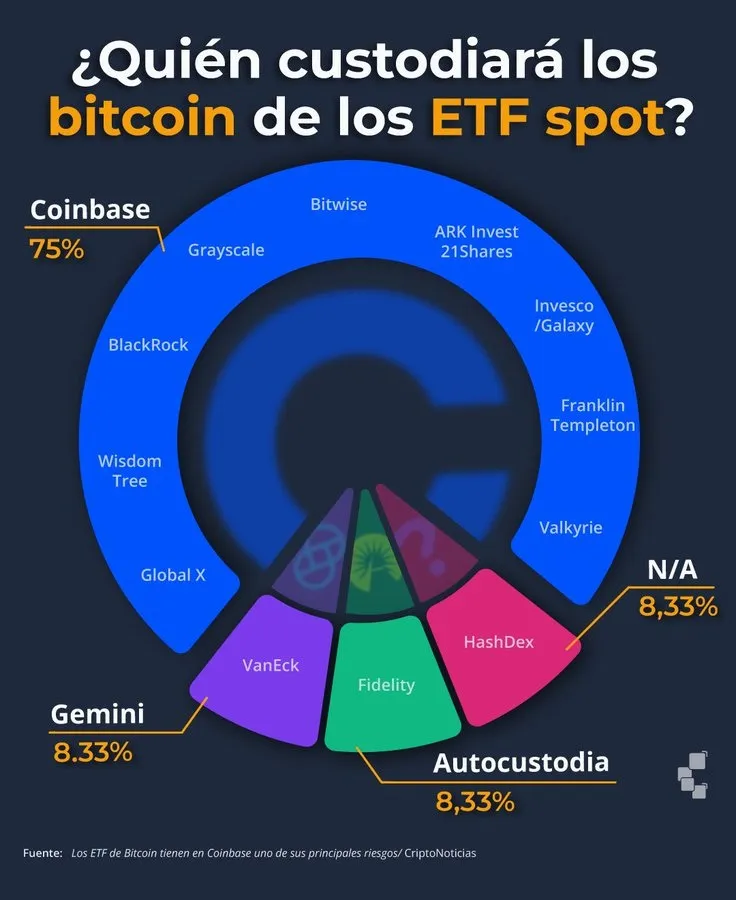
Source: Criptonoticias
The financialization of the bitcoin market refers to the introduction of reckless or “toxic” practices present on Wall Street, such as excessive leverage and trading non-existent assets that artificially inflates supply. This is perfectly possible, because what is actually traded is “paper BTC”.
It has also been mentioned that ETF-issuing institutions could try to accumulate large amounts of bitcoin, to gain some authority in the community, and try to influence how the protocol is maintained. However, given the characteristics of the network and how it currently works, this idea seems unlikely for now.
So, are ETFs positive or negative for bitcoin?
The answer to this question may not be binary. For 10 years, investment fund managers kept asking the SEC for authorization to issue a product like this. This, at the very least, shows a great appetite for bitcoin as an investment vehicle.
Recently, economist Juan Ramon Rallo pointed out that ETFs respond to a very strong underlying demand. “It is the confirmation that bitcoin has become an asset class” in investors’ portfolios, Rallo said.
It could be said that the arrival of stock market players and acceptance by regulators represents the definitive disappearance of old anti-bitcoin narratives. On the other hand, there are those who trust that Bitcoin’s current purpose will prevail.
Jeffrey Ross, founder of Vailshire Capital, predicts that bitcoin ETFs will only be a temporary solution, a transition toward traditional financial instruments being replaced by Bitcoin. “The longer people hold bitcoin, the more incentive they will have to learn what it really is. The younger generation will inherit their parents’ wealth and will sell these ETFs and buy bitcoin,” Ross told a news portal.